বিসর্জন – একটি আবেগঘন বাংলা গল্প | সুজয় মুখার্জী
A Comprehensive Guide to Computer Vision's Most Powerful Architecture
In the rapidly evolving landscape of artificial intelligence and computer vision, Convolutional Neural Networks (CNNs) have emerged as the cornerstone technology powering modern visual recognition systems. From facial recognition in smartphones to medical diagnostics and autonomous vehicles, CNNs have fundamentally transformed how machines interpret and understand visual data.
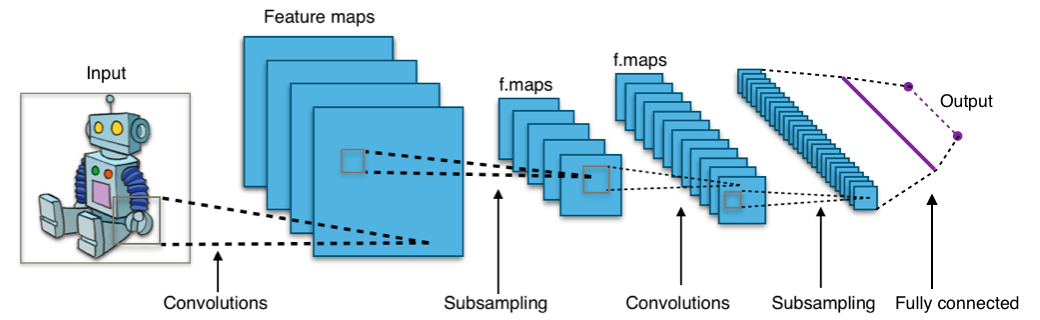
The revolutionary power of CNNs lies in their ability to automatically and adaptively learn spatial hierarchies of features directly from raw pixel data through backpropagation, using specialized building blocks like convolutional layers, pooling layers, and fully connected layers.
Unlike traditional computer vision approaches that required manual feature engineering, CNNs learn optimal feature representations automatically, making them exceptionally versatile and powerful for a wide range of visual tasks.
CNNs excel at learning features in a hierarchical manner – early layers detect simple patterns like edges and colors, while deeper layers combine these to recognize complex objects and patterns.
Processes raw pixel values (height × width × channels). For RGB images: 3 channels (Red, Green, Blue).
Apply learnable filters to extract features via convolution operations, producing feature maps.
Introduces non-linearity using ReLU: f(x) = max(0, x), enabling complex pattern learning.
Reduce spatial dimensions while retaining important features (Max Pooling, Average Pooling).
| Architectural Feature | Technical Benefit | Practical Impact |
|---|---|---|
| Parameter Sharing | Drastically reduces number of parameters (vs. fully connected) | Faster training, lower memory requirements |
| Sparse Connectivity | Each neuron connects only to local receptive field | Computational efficiency, captures local patterns |
| Translation Invariance | Patterns recognized regardless of position | Robust to object location changes |
| Hierarchical Learning | Simple → Complex feature abstraction | Automates feature engineering |
| Spatial Pooling | Dimensionality reduction with feature retention | Improved generalization, reduced overfitting |
Pioneering architecture for digit recognition, established the CNN blueprint.
Revolutionized the field, introduced ReLU, dropout, and GPU training.
Proved depth improves performance with uniform 3×3 convolutions.
Solved vanishing gradients with residual connections, enabling 100+ layers.
Optimal scaling of depth, width, resolution for efficiency.
Transformer architecture applied to images, challenging CNN dominance.
Disease detection in X-rays, MRIs, and CT scans
Object detection, lane recognition, obstacle avoidance
Land use analysis, deforestation tracking, urban planning
Style transfer, image generation, artistic applications
Face recognition, anomaly detection, crowd analysis
Quality control, defect detection, robotic vision
Cross-entropy for classification, MSE for regression, specialized losses for segmentation/ detection
Adam, SGD with momentum, learning rate scheduling, gradient accumulation
Dropout, weight decay, batch normalization, data augmentation
GPUs/TPUs for parallel computation, mixed precision training, distributed training
Convolutional Neural Networks have fundamentally transformed computer vision and continue to drive innovation in artificial intelligence. Their unique ability to learn hierarchical feature representations directly from visual data has made them indispensable for a wide range of applications.
As the field evolves, we are witnessing exciting developments in CNN efficiency, interpretability, and integration with other neural architectures like Transformers. The future of computer vision lies in hybrid models that combine the spatial processing strengths of CNNs with the contextual understanding of attention mechanisms.
Whether you're a researcher, developer, or enthusiast, understanding CNNs is essential for working with visual AI. This guide provides the foundation to explore more advanced topics and contribute to the next generation of intelligent vision systems.
Specializing in deep learning, computer vision, and neural architecture design. Passionate about making complex AI concepts accessible to developers and researchers worldwide.
Comments
Post a Comment